
Enough to Spare & Share: Stone Soup PDX
Stone Soup PDX pairs paid culinary job training with a community meals program that now produces more than 2,100 scratch-made meals a week. In this interview, the Stone Soup team shares how the model grew, how partnerships make it work, and how its Jewish roots shaped its mission. Read on to learn more about the organization, and how you can get involved.
“Enough to Spare & Share” is your tagline. Where did it come from?
“Enough to Spare & Share” reflects the spirit in which Stone Soup PDX was founded: the belief that when a community comes together and contributes what it can, we can create something much greater than any one person could accomplish alone.
Our name comes from the familiar Stone Soup folktale, in which neighbors each contribute a little something to a shared pot, ultimately creating a meal that nourishes everyone. That same philosophy guides our work today. We bring together people, resources, food, skills, and opportunities to build a stronger community.
The early plan for the organization centered on a training restaurant. Today there’s culinary training, community meals, and a café on NE Glisan. How did the model grow, and what drove those decisions?
Stone Soup PDX was founded in 2018 and opened in 2019 with a vision of creating economic opportunity through food and hospitality.
Just six months later, the COVID-19 pandemic reshaped those plans. As Multnomah County established shelters for people experiencing homelessness, Stone Soup coordinated a community-wide effort with local restaurants and meal providers to deliver nutritious meals to shelter residents.
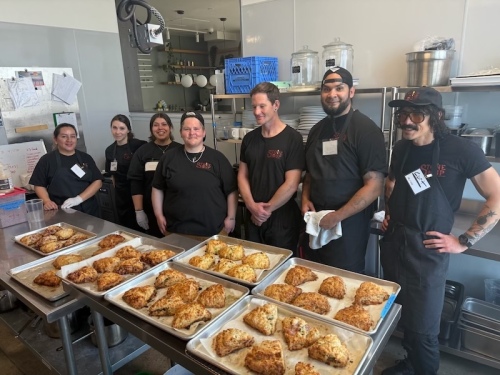
When the shelters closed, we saw that community meal production could serve two purposes: provide a reliable source of earned income and create meaningful hands-on training opportunities. Today, our Community Meals Program produces more than 2,100 scratch-made meals each week, while our café at Glisan Landing gives participants experience in customer service, barista skills, and front-of-house operations.
What began as a response to a crisis has become a defining part of our model: using food to create both economic opportunity and community nourishment.
You partner with groups like Catholic Charities, Central City Concern, Goodwill, WorkSource Oregon, and Multnomah County. How do those relationships work in practice?
Partnerships are essential to nearly everything we do. Many participants are navigating housing instability, recovery, justice-system involvement, or long periods outside the workforce, and no single organization can address all those challenges alone.
Community partners help connect people to our program, provide complementary services, and support participants as they work toward stability. We also work closely with employers who value hands-on training and increasingly focus on opportunities that offer stable schedules, competitive wages, benefits, and pathways for advancement.
Similarly, organizations serving seniors, families, children, and others rely on Stone Soup for nutritious prepared meals, allowing them to focus more resources on the services they provide. These relationships are built on a simple idea: We can accomplish more together.
What’s next? What might Stone Soup look like in five years?
Our vision is to grow both the reach and long-term impact of our programs.
Beginning in 2027, we plan to expand our training capacity by adding another cohort and increasing enrollment, with a goal of serving approximately 110 participants annually. We’ll also continue strengthening post-graduation support and career pathways, particularly by connecting graduates with employers offering competitive wages, benefits, predictable schedules, and opportunities for advancement.
At the same time, we hope to expand our Community Meals Program to nourish more people throughout Portland while continuing to strengthen our workforce-readiness curriculum and credentials.
Five years from now, we’d like Stone Soup to be recognized not only as a culinary training program or meal provider, but as an important part of Portland’s workforce development and food security infrastructure.
The website cites 357,000 meals served, 28,000 training hours, and 6,001 volunteer hours. What do those numbers capture, and what do they miss?
Those numbers represent an enormous amount of work, generosity, and community collaboration, but they only tell part of the story.
A training hour may represent someone gaining confidence or discovering a new skill. A meal may ease a burden for a family or allow a partner organization to focus more resources on housing, recovery, or other essential services.
We care deeply about outcomes, but some of our most meaningful successes are difficult to measure. Ultimately, those numbers represent people: participants building greater independence, neighbors receiving nutritious meals, and volunteers and partners helping make it all possible.
What does a graduate’s path look like, from application to a job? What outcomes do you track?
Our Culinary Workforce Development Program is a 12-week paid training program for adults experiencing barriers to employment. Participants gain foundational kitchen skills, workplace experience, and hands-on training in our production kitchen and café.
To help participants succeed, we provide a training stipend, transportation assistance, daily meals, kitchen equipment, and individualized support. Our Employment Specialist assists with resumes, interviews, job searches, and employer connections, and continues providing support after graduation.
We track enrollment, graduation, employment outcomes, and long-term career progress. While we’re proud of graduation rates as high as 89%, our ultimate measure of success is whether participants are building lasting financial and housing stability.
How do the community meals change the neighborhoods and organizations you serve?
Our Community Meals Program is about more than food. It helps create stability while supporting organizations serving people experiencing food insecurity.
We produce more than 2,100 nutritious meals each week for seniors, families, preschoolers, and individuals receiving housing and behavioral health services. Having a reliable source of prepared meals allows our partners to focus more of their resources on the services they provide.
Because these meals are prepared in a workforce-training environment, every meal serves two purposes: nourishing our community and helping someone build skills for a more stable future.
What do you hear from restaurants and employers who hire your graduates?
Building strong relationships with employers is an increasingly important part of our work. While restaurants remain valuable partners, we’re also expanding connections with hospitals, schools, senior living facilities, corporate dining programs, and other employers that can offer stable jobs with competitive wages, benefits, and opportunities for advancement.
Earlier this year, we added a full-time Employment Specialist to strengthen those relationships and provide more individualized support to participants as they transition into the workforce. We’re also creating a more consistent process for gathering employer feedback, so we can better understand where our graduates excel and how we can continue improving our training.
Ultimately, we want employers to see Stone Soup as a reliable source of motivated, well-prepared candidates while ensuring our graduates enter workplaces where they can succeed and grow.
How has the Jewish community in Portland supported Stone Soup, and how has the organization given back?
Stone Soup PDX was founded by members of Portland’s Jewish community, whose relationships and support helped bring the organization to life. Over the years, Jewish individuals and families have continued to support our work through philanthropy and personal connections, including gifts made through donor-advised funds at the Oregon Jewish Community Foundation. We are deeply grateful for that generosity.
Our founders have often referenced tikkun olam—the Jewish value of repairing the world—as an inspiration for Stone Soup’s mission. As a secular nonprofit serving people of all backgrounds, we carry that spirit forward by creating opportunities for individuals facing barriers to employment and preparing meals for neighbors experiencing food insecurity. In this way, we hope to honor the generosity and values that helped establish Stone Soup by extending that care throughout the broader Portland community.
Is there anything you want people to understand about Stone Soup that they might not know?
Many people are surprised to learn that our workforce development and community meal programs are intentionally connected.
Participants learn in a working production kitchen where the food they prepare directly serves people throughout the community. That creates a strong sense of purpose while helping participants build skills that can lead to employment and greater independence.
Our focus extends beyond helping someone find a job. We want participants to access opportunities that support long-term stability and provide a foundation for the future. Ultimately, our work is about dignity, opportunity, and the belief that everyone deserves a chance to thrive.
How can people get involved right now?
There are many ways to support Stone Soup PDX, from making a donation or volunteering to introducing us to potential employers and community partners.
One of the most exciting opportunities coming up is The Portland Soup Showdown, our annual fundraiser that brings together local chefs and restaurants in support of our workforce development and community meal programs. We’re also preparing for our year-end fundraising campaign through Give!Guide.
For those looking to make a deeper investment, unrestricted gifts are especially impactful because they allow us to respond to emerging needs, strengthen participant support, and invest in the long-term sustainability of our programs. We’re always happy to connect with individuals and families interested in learning more about our work or exploring ways to get involved.
Learn more at stonesouppdx.com.
long walks, being with my family and friends. Exploring. So many possibilities!


